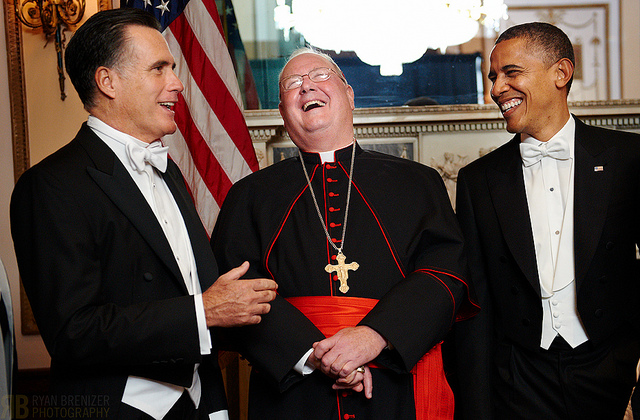
This week Timothy Dolan, the Archbishop of New York and President of the US Conference of Catholic Bishops, addressed a group of priests calling for repentance. Repentance is, Dolan said, “the way we become channels of a truly effective transformation of the world, through our own witness of a repentant heart…The premier answer to the question ’What’s wrong with the world?’ is not politics, the economy, secularism, sectarianism, globalization or global warming, [but rather], ‘I am.’”
I wish, along with many other religious people across the country, that Dolan had made this realization sooner. Instead, these remarks came on the heels of an intense battle during the election season. In the weeks leading up to the election, Dolan had become a figurehead on the conservative side of several culture wars, most notably expressing “horror” over the “radical intru[sion]” of the religious exemption to the healthcare mandate. Despite his criticisms, the majority of Catholics voted for President Obama, as did religious voters in general, according to a recent report in the Huffington Post. Even among groups that are usually staunchly Republican, such as white evangelicals, the margins were closer among voters under 40 — a sign that this is only the beginning of a groundswell of change that could completely reshape the role of faith in American public life over the next few generations.
What is particularly stinging about this loss for conservatives like Dolan is that they succeeded in rallying an unprecedented multi-million-dollar concerted effort to cast President Obama (again) as anti-religious. He was, they told us, conducting a “war on religion,” or alternatively, a “war on Catholicism.” Rick Santorum accused Barack Obama of having a “phony theology.” Franklin Graham also publicly questioned Obama’s Christianity. Karl Rove and his conservative super-PAC promised to pull no punches in linking Obama to “radicals” like Jeremiah Wright (also, again). Mitt Romney even garnered support late in the game from the reverend Billy Graham, who, at Romney’s behest, removed references to Mormonism as a cult from his organization’s website. (Do I even have to point out the irony that Obama’s faith was such a threat, while Romney’s non-adherence to Christianity didn’t seem to matter?)
I’m glad for Dolan’s change of tone and — hopefully — change of heart, but it seems that he and the conservative evangelicals he has partnered with still don’t get it. They feel as though they’ve lost a generation, or maybe an entire culture to a secular worldview. They think that the power of religion is waning in the public sphere. They’re looking at their own parishioners lamenting what they see as a loss of morals. They believe their own congregations are walking out on the faith in droves. All they can do is retreat, retool, and think of new strategies to win the culture back.
Still, in simply retreating and focusing on their own individual repentance, I worry that Dolan and others like him have completely missed the powerful change that is happening all around them.
What leaders like Dolan don’t see is that none of their parishioners left their faith at home when they went to the polls last Tuesday. What they don’t see is that people of faith voted for Barack Obama because of their faith, not in spite of it. What they don’t see is that people of faith in America are finally waking up to new ways of expressing their faith, ways which call them to solidarity with oppressed people rather than preoccupation with individual moral concerns. These people of faith are recognizing that perhaps there are ways to use government in our pursuit of the common good, rather than using it to become the moral police of the world.
Over 2,000 verses in the Bible speak of caring for people in poverty, foreigners, and dispossessed people such as widows and orphans. This tradition is so strong that Christianity Today reports that people who read the Bible frequently, even those that identify themselves as socially conservative, tend to favor the “liberal” side of many social issues such as immigration. Walter Bruggeman, the greatest living scholar of the Hebrew Bible in America, puts it this way:
“The most elemental passion of the prophetic tradition assumes that evangelical faith has little to do with private piety and everything to do with the systemic maintenance of a humane infrastructure.”
It was Bruggeman’s immersion in the justice tradition of the Bible that led him to assert that:
“We are witnesses, at the outset of the Obama administration, of a new political conversation in which the old ingredients of humaneness come into view again. Talk of health care, job security, and educational access are all particular manifestations of justice and righteousness that are grounded in a communitarian solidarity that prophets, from Sinai on, term ‘steadfast love.’” (from Journey to the Common Good)
For decades, the Republican party has concerned itself with one social issue to the exclusion of all others: abortion. This has proven to be a very politically advantageous position. Abortion became a conservative tool, a political trump card, allowing Republicans to appear to have the moral high ground: who is morally callous enough to care about stricter gun control while the unborn are not protected, or so the argument goes. This was a strategy that helped many Republicans since Roe v. Wade into office.
Nevertheless, during his eight years as president, George W. Bush like other “pro-life” Republican presidents before him, instituted no comprehensive plan to reduce the number of abortions in this country. However, around the same time, Barack Obama inserted into the Democratic platform the commitment to “strongly support a woman’s decision to have a child by ensuring access to and availability of programs for pre- and post-natal health care, parenting skills, income support, and caring adoption programs.” As president, he has stood on this commitment. The Affordable Care Act (“Obamacare”), by providing women with FDA-approved contraceptives without a copay, has been projected to prevent between 41% and 71% of all abortions currently performed in the United States. Thomas Groome, a professor of Theology at Boston College and national Co-Chair of Catholics for Obama, summarizes Obama’s other accomplishments as follows:
“President Obama has signed into law the Pregnancy Assistance Fund – a $250 million program that helps local organizations support vulnerable pregnant women who wish to have their babies. He has extended and tripled the Adoption Tax Credit and proposes making it permanent. He supports the Child Tax Credit, which the Romney/Ryan budget would [have] cut. Going forward, his overall social policies and affordable health care will insure that the US rate of abortions will decline significantly.” (See Groome’s complete statement, “For Obama Because Against Abortion,” by clicking here.)
People of faith aren’t stupid. We know that no matter how much a candidate insists that he or she is “pro-life” we ultimately have to look at the “fruits” that result from actual policies, and in this department President Obama has done more than any other president since Roe v. Wade, Republican or Democrat.
What’s more, President Obama’s commitment to actually do something about abortion in America is only part of his strong record on important social issues. Just to give a few examples, this list includes:
- Ending the war in Iraq, winding down the war in Afghanistan, and sustaining an effort to avoid future militarism
- Ending the use of torture
- Promoting gender equality, and reducing violence against women
- Creating opportunities for success for people with disabilities
- Making the largest possible effort to reverse global climate change
- Providing the best possible educational environment for children
This is just a tiny sampling, and don’t include the efforts that Obama will make on similar issues in his next term.
These issues are all part of our sacred obligation to care for those around us: “whatever you did for one of the least of these brothers and sisters of mine, you did for me.” (Matthew 25:40). As we pursue this mandate, why should we not use whatever tools are available? We have to stop pretending that American Democracy — a government that is “for the people, by the people” — is doomed to be some sort of pernicious meddling force that prevents true love and charity. As the philosopher Cornel West says, “justice is what love looks like in public.”
On November 6, religious Americans made the statement that we pursue the common good together. I’m happy to have a president whose agenda allows me to address the main issues that I see affecting the world I live in and the world I will give to my children. I’m confident that he will continue, however imperfectly, to make progress. As Martin Luther King, Jr., said, “the church must be reminded that it is not the master or the servant of the state, but rather the conscience of the state. It must be the guide and the critic of the state, and never its tool.”
I would never say that Barack Obama or Democrats in general present the only right way for religious people to be the “conscience of the state.” I do believe, however, that at least this time around, they have offered a larger and more compelling set of ways to achieve this goal. And, most importantly, I believe we are seeing the end of an era in which American Christianity serves as a tool for conservative politics. That is the hope and change I believe in, the hope and change that will come from a new era for faith in the American public sphere.
 Brett Beasley